Etymology
The common name "hellebore" is first attested in the 1300s; it originates, via Old French and Latin, ultimately from Ancient Greek: ἑλλέβορος, romanized: helléboros. Although traditionally translated as "plant eaten by fawns", this could be folk etymology and, according to Beekes, really a Pre-Greek word.[6] It is not related to the word "hell", despite the toxic nature of this plant.
In Anglo-Saxon England, the Anglo-Latin word elleborus had varied meanings. Around 900 AD, it was linked with "tunsingwyrt" (various spellings; likely an allium such as wild garlic) in the Old English Herbarium. Ælfric of Eynsham seemed to assert that elleborus had no vernacular Old English translation; by the early 11th century, "wodewistle" was used to gloss the word, possibly referring to hemlock or similar. These shifts reflect the developing understanding of Latin plant names in Old English texts.[7]
Description
The flowers have five petal-like sepals surrounding a ring of small, cup-like nectaries, which are actually petals modified to hold nectar. The sepals do not fall as petals would, but remain on the plant, sometimes for many months. The persistence of the sepals may contribute to the development of the seeds.[8]
Taxonomy
The genus was established by Carl Linnaeus in volume one of his Species Plantarum in 1753.[1]
The scientific name Helleborus could derive from the Ancient Greek word ἑλλέβορος (helléboros), the common name for H. orientalis, constructed from ἑλεῖν (heleîn, "to injure") and βορά (borá, "food").[9][10][11] It is also possibly from Greek, ἄλκη (“fawn”) and βιβρώσκω (bibrṓskō, “to eat”).[12]
Hellebore Hybrids / Interspecific Hybrids
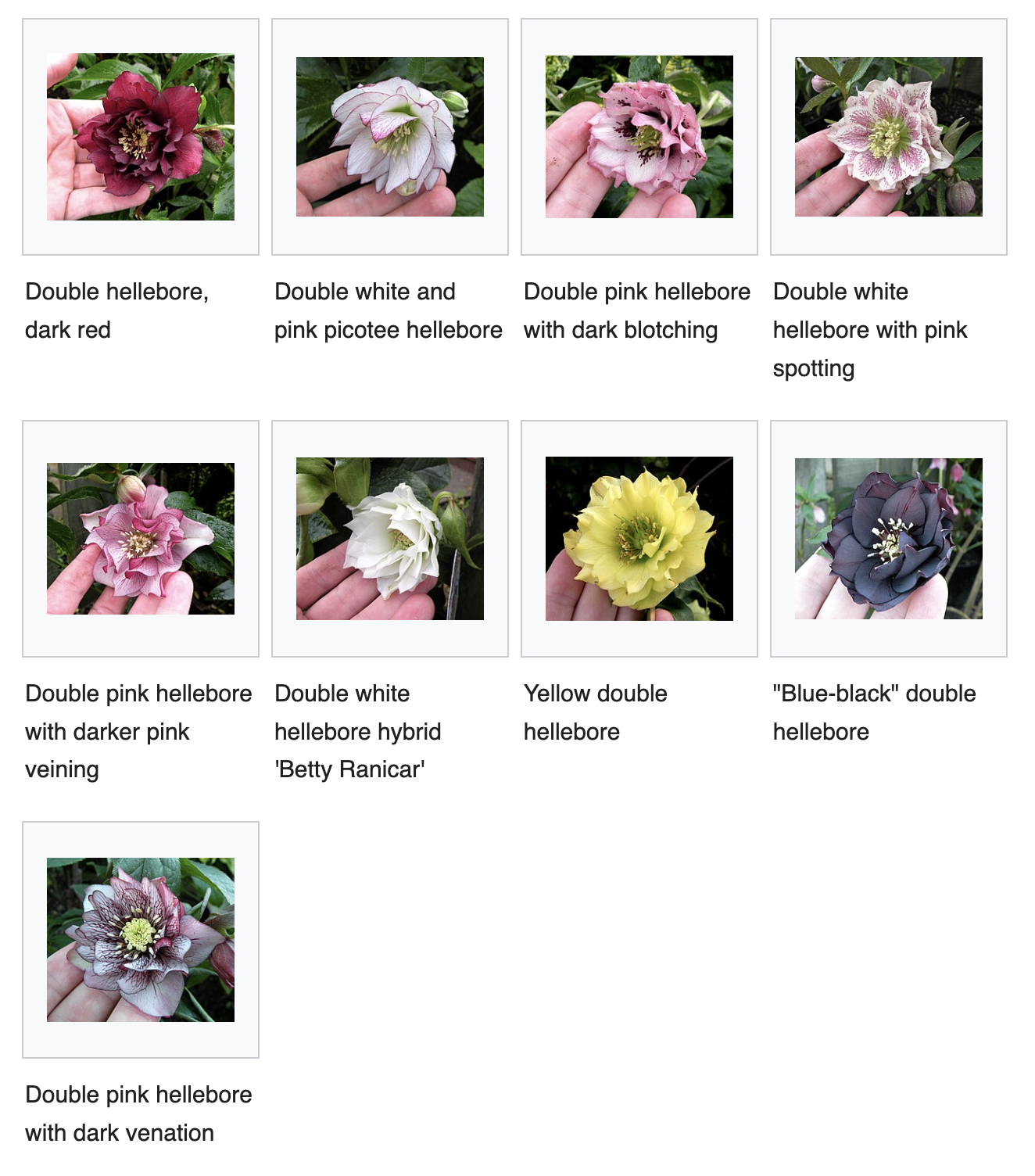
Hybridising (deliberate and accidental) between H. orientalis and several other closely related species and subspecies has vastly improved the colour range of the flowers, which now extends from slate grey, near-black, deep purple and plum, through rich red and pinks to yellow, white, and green. The outer surface of the sepals is often green-tinged, and as the flower ages it usually becomes greener inside and out; individual flowers often remain on the plant for a month or more. The inner surface of each sepal may be marked with veins, or dotted or blotched with pink, red, or purple. "Picotee" flowers, whose pale-coloured sepals have narrow margins of a darker colour, are much sought-after, as are those with dark nectaries which contrast with the outer sepals.
Recent breeding programmes have also created double-flowered and anemone-centred plants. Ironically, doing this is actually reversing the evolutionary process in which hellebores' true petals had been modified into nectaries; it is usually these nectaries which become the extra petals in double, semi-double, and anemone-centred flowers. Double-flowered hellebores[17] provide a very interesting variation to the standard hellebore. They are generally easy to maintain and share the same planting conditions as the standard hellebore.
Semi-double flowers have one or two extra rows of petals; doubles have more. Their inner petals are generally very like the outer ones in colour and patterning. They are often of a similar length and shape, though they may be slightly shorter and narrower, and some are attractively waved or ruffled. By contrast, anemone-centred flowers have, cupped within the five normal outer petals, a ring of much shorter, more curved extra petals (sometimes trumpet-shaped, intermediate in appearance between petals and nectaries), which may be a different colour from the outer petals. These short, extra petals (sometimes known as "petaloids") drop off after the flower has been pollinated, leaving an apparently single flower, whereas doubles and semi-doubles tend to retain their extra petals after pollination.
Distribution
Various species of this genus originated in Europe and Asia.[25] The greatest concentration of species occurs in the Balkans. One atypical species (H. thibetanus) comes from western China; another atypical species (H. vesicarius) inhabits a small area on the border between Turkey and Syria.
Pests & Diseases
Insects
Phytomyza hellebori (Hellebore Leaf Miner)
More commonly known as the Hellebore leaf miner, Phytomyza hellebori is a small fly that infests only the H. foetidus plants in the Hellebore genus. The leaf miner fly digs tunnels into the leaves, creating brownish-black blotches that later become nesting grounds for egg-laying. Over time, the leaves turn brownish-white along the tunnels. Larvae feed inside the leaves from August, with damage developing from late summer to early spring. Heavy attacks can leave the foliage disfigured by spring.[26]
To control heavy infestations, remove and destroy affected leaves during winter before adult flies emerge. Insecticides may be used but are only moderately effective against larvae and flies, and they can harm non-leaf-miner insects if applied during the hellebore's flowering period.[26]
Macrosiphum hellebori (Hellebore Aphid)
Macrosiphum hellebori, commonly known as 'Hellebore aphid' or 'greenfly', is a sap-feeding aphid that infests the flowers and foliage of hellebore plants. The whitish-green aphids are about 2–4 millimetres (3⁄32–5⁄32 inch) long and form dense colonies on hellebores, coating them with a honeydew that can lead to the growth of sooty mold on the leaves and flowers of the hellebore. This species of aphid only affects hellebores and is most active in March and April when the hellebores are flowering and when few aphid predators are around, though they may infest during any time of the year.[27][28] Aphids start their feeding from the outside the flowers, beginning at the leaves and then moving towards the flower petals of the hellebore. As the hellebore begins to open, the aphids try to move into the flower. The aphids then feed on the inner parts of the plant as well as the young stems and shoots. As the population grows, the aphids eventually eat the remaining parts of the plant, such as older leaves, for food.[28] Aphid infestations can be controlled through persistent squashing of the aphids manually or by using insecticides. It is not recommended to spray flowering hellebores as it may harm the non-aphid pollinating insects.[27]Diseases
Botrytis cinerea (Grey Mold)
Botrytis cinerea, or grey mold, is a fungal disease that infects most ornamental plants. It decays plant tissues and produces fuzzy gray-brown mold over affected areas such as buds, leaves, and flowers. Infected parts may shrivel and die, especially the flowers. The fungus typically enters through open wounds or when the plant is under stress, but it can also infect plants in humid conditions. Low humidity may limit the mold to discrete spots, but in highly humid conditions, it spreads rapidly. Grey mold is not season-dependent and can affect plants at any time. The fungus produces black seed-like structures in dead tissue to form spores, which spread through the air to new plants.[29]
Treatment involves removing infected and dying leaves, buds, and flowers immediately, along with any other dead plant material surrounding the hellebore. Reducing humidity by improving ventilation and avoiding overcrowding is also recommended.[29]
Coniothyrium hellebori (Black Spot / Leaf Spot)
Coniothyrium hellebori is a fungus that causes the most common fungal disease for hellebore species, known as Hellebore black spot or leaf spot. The disease is prevalent in botanical and ornamental gardens as well as hellebore nurseries. Visible symptoms include blackish-brown spots, often forming rings on the leaf blade or margins. These spots enlarge over time, keeping an elliptical or circular shape and darkening to brown or black. Infection can spread to the entire leaf, and occasionally petioles and flowers, though leaves are primarily affected. Symptoms typically appear in spring and worsen as the season progresses.[30]
Small black fruiting bodies, called pycnidia, develop in the dead cells of leaf spots and carry spores. These spores are mainly dispersed by water, wind, and wind-blown rain. The fungus thrives at the growth site of hellebore plants, and spores may persist for many years if untreated. The most effective control method is to remove and destroy infected leaves immediately to prevent reinfection the following spring.[30]
Helleborus Net Necrosis Virus (Black Death)
Helleborus net necrosis virus (HeNNV), also known as Hellebore black death, is an RNA virus that can severely affect hellebore plants, stunting or deforming growth. The disease produces black streaks along the leaf veins, often forming ring patterns. Sepals and flowers may also develop black spots or streaks, though not always. In severe cases, new leaves have limited growth and may die off.[31]
The species most seriously affected in the UK is H. orientalis, but all hellebores are susceptible.[32] The most effective treatment is to dig up and destroy all infected plants immediately. Since many viruses are not transmitted through seeds, raising new plants from seed can produce disease-resistant specimens.[32]
Pseudomonas viridiflava
Pseudomonas viridiflava is a bacterium reported to cause disease in hellebores in New Zealand and other plants. The bacterial infection manifests as black leaf spots, petal necrosis, and stem lesions. The most widely cultivated ornamental and commercial crop in New Zealand is H. orientalis and its hybrids, of which 90% of the H. orientalis in a Tauranga nursery contracted the disease after several days of moderate rainfall.
Symptoms include circular black leaf spots 1.5–2 mm in diameter, black stem lesions, and dry grey-to-brown lesions with distinct margins on the flower petals. These symptoms differ from other hellebore leaf-spotting diseases caused by fungi like Coniothyrium or bacteria like Xanthomonas[33]. The New Zealand case is the only reported infection of hellebores by P. viridiflava, though in other plants it can also cause leaf rot, leaf blotch, stem necrosis, and blossom blight.[33]
Horticulture
Hellebores are widely grown in United States Department of Agriculture hardiness zones 5a to 8b gardens for decorative purposes. They are particularly valued by gardeners for their winter and early spring flowering period; the plants are surprisingly frost-resistant and many are evergreen.[34] They are also appreciated for their shade tolerance.[4]
Many species have green or greenish-purple flowers and are of limited garden value, although Corsican hellebore (H. argutifolius), a robust plant with pale green, cup-shaped flowers and attractive leathery foliage, is widely grown. The "stinking hellebore" or setterwort (H. foetidus) produces drooping clusters of small, pale green, bell-shaped flowers, often edged with maroon, contrasting with its dark evergreen foliage. Cultivars such as H. foetidus 'Wester Flisk', with red-flushed flowers and flower stalks, are gaining popularity, as are newer selections with golden-yellow foliage.[citation needed]
The so-called Christmas rose (H. niger), a traditional cottage garden favourite, bears pure white flowers, which often age to pink, in the depths of winter. Large-flowered cultivars, as well as pink-flowered and double-flowered selections, are also available.
The most popular hellebores for garden use are H. orientalis and its colourful hybrids, H. × hybridus (Lenten rose). In the northern hemisphere, they flower in early spring, around Lent, and are often called Lenten hellebores, oriental hellebores, or Lenten roses. They are excellent for bringing early colour to shady herbaceous borders and areas beneath deciduous shrubs and trees.
Toxicity
All Helleborus plants are toxic, and all parts of the plant contain toxins.[9][35] Hellebore poisoning is rare, but it can occur.[9]
Animals such as deer and rabbits generally avoid hellebores because the leaves contain toxins, making them distasteful. Gardeners with sensitive skin may sometimes experience irritation.[36] Historically, hellebore was used in the First Sacred War (6th century BC) to poison the water supply of the city of Kirrha.
Poisoning occurs through ingestion or handling. Ingesting hellebores is especially dangerous in large quantities. Symptoms include burning of the mouth and throat, salivation, vomiting, abdominal cramping, diarrhea, nervous symptoms, and possibly depression. Severe poisoning can be fatal.[35] Toxic steroids are present in the roots, while ranunculin and protoanemonin, especially in the leaves and sap, also contribute to toxic effects.[9]
Dermatitis can result from handling hellebores without protection, due to ranunculin and protoanemonin on leaves, stems, flowers, and sap. Irritation and burning usually subside within minutes, but persistent symptoms require washing and medical attention.[9][35] When collecting seeds, it is recommended to wait until pods are dry and shake them into a container or onto the ground to avoid chemical burns.
The species historically known as "black hellebore" (H. niger) can cause tinnitus, vertigo, stupor, thirst, anaphylaxis, vomiting, catharsis, bradycardia, and potentially death from cardiac arrest.[37] Although black hellebore contains protoanemonin[38] and ranunculin[39], research in the 1970s showed its roots do not contain cardiotoxic steroids helleborin, hellebrin, or helleborein, which are responsible for the lethal reputation. Earlier studies may have used preparations containing material from other species, such as H. viridis (green hellebore).[39]
Uses
In the early days of medicine, two kinds of hellebore were recognized: black hellebore, which included various species of Helleborus, and white hellebore, now known as Veratrum album[37], which belongs to a different plant family, the Melanthiaceae.[41] Although white hellebore contains highly toxic, teratogenic alkaloids such as veratrine, cyclopamine, and jervine, it is believed to be the "hellebore" used by Hippocrates as a purgative.[citation needed]
Despite the serious risks, "black hellebore" was used by the Greeks and Romans to treat paralysis, gout, and psychosis.[42]
Culture
H. niger is commonly called the Christmas rose, due to an old legend that it sprouted in the snow from the tears of a young girl who had no gift to give the Christ Child in Bethlehem.[43]
In Greek mythology, Melampus of Pylos used hellebore to save the daughters of the king of Argos from a madness induced by Dionysus, which caused them to run naked through the city, crying, weeping, and screaming.[44]
During the Siege of Kirrha in 585 BC, hellebore was reportedly used by the Greek besiegers to poison the city's water supply. The defenders were subsequently so weakened by diarrhea that they were unable to defend the city from assault.[45]
In a fit of madness induced by Hera, Heracles killed his children. His madness was cured using hellebore.[46]
Gallery
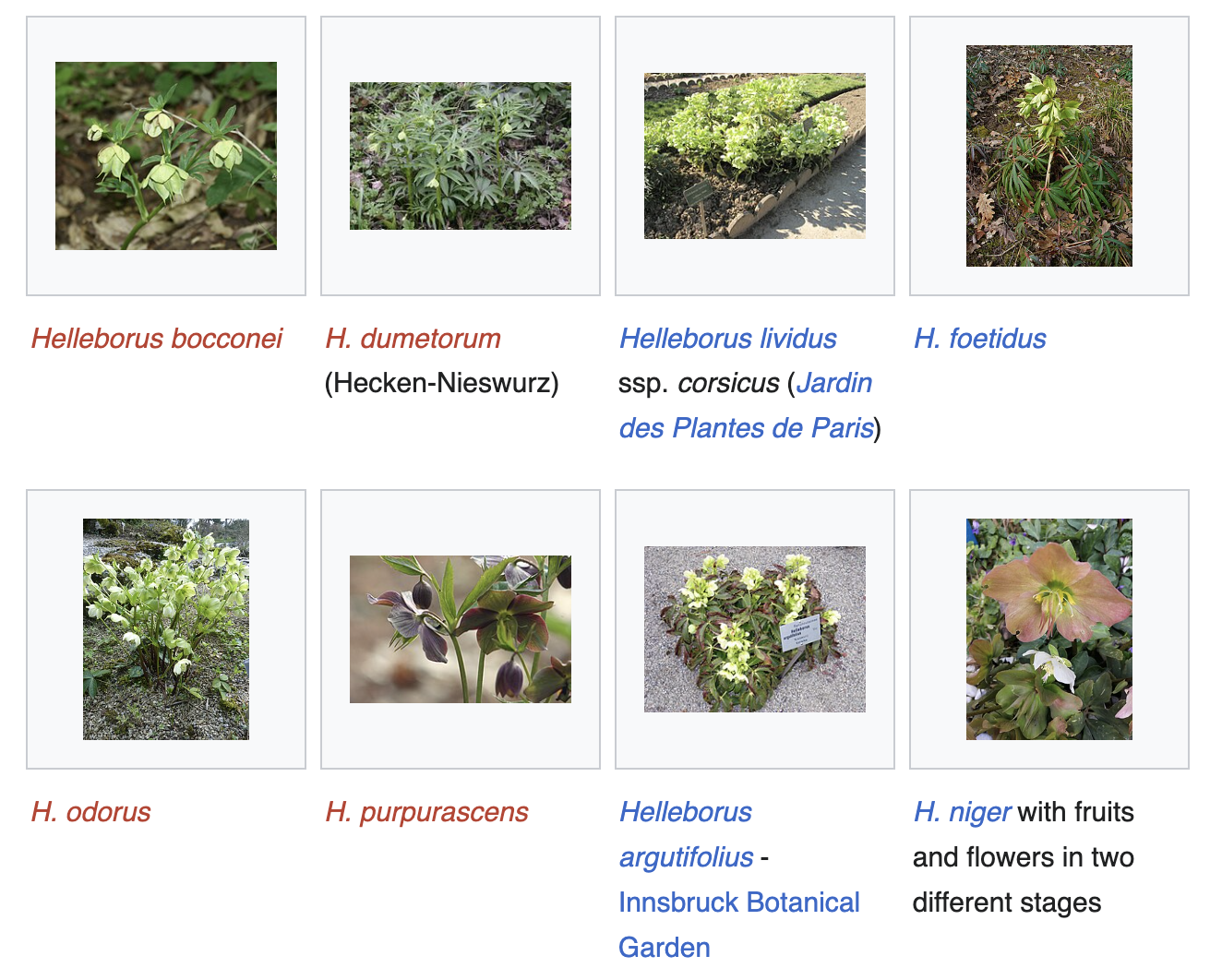
Species
Hybrids
See also
Further Reading
- Rice, Graham & Elizabeth Strangman (1993). The Gardener’s Guide to Growing Hellebores. David & Charles/Timber Press. ISBN 0-7153-9973-X
- Mathew, Brian (1989). Hellebores. Alpine Garden Society. ISBN 0-900048-50-6